Car Accident Lawsuit Timeline: How Long Each Stage Actually Takes
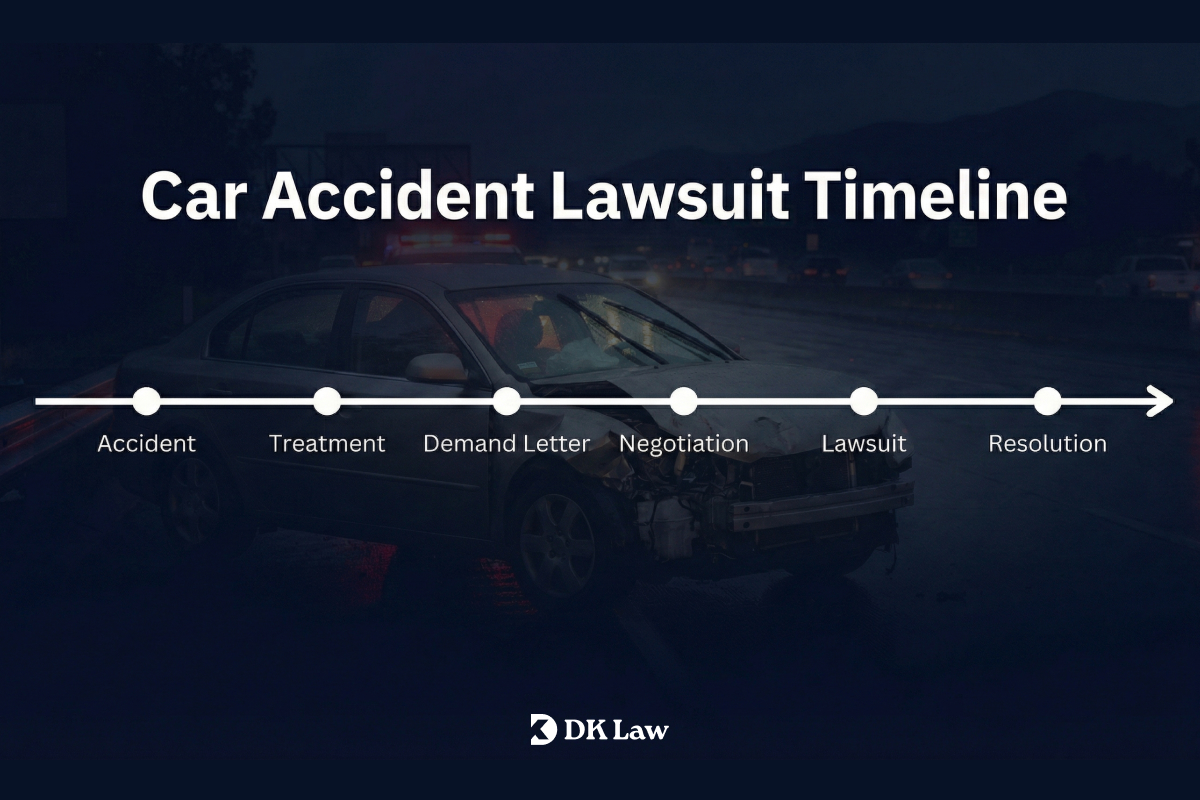
If you’ve been in a car accident in California and you’re thinking about filing a claim or a lawsuit, you probably have one question bouncing around your head louder than everything else: how long is this going to take?
The honest answer is somewhere between a few months and a few years. It depends on how badly you’re hurt, whether the other driver’s insurance company plays fair, and whether your case needs to go to court. Most don’t. But some do, and the timeline changes a lot depending on which path yours takes.
Here’s what the process actually looks like, stage by stage, based on the hundreds of car accident cases we’ve handled across California.
Key Takeaways
- Most car accident claims in California resolve in 6 to 18 months without ever going to trial. Complex cases with severe injuries can take 2 years or longer.
- Your medical treatment timeline drives the overall case timeline. Attorneys don’t (and shouldn’t) settle your case until you’ve reached maximum medical improvement.
- About 97% of personal injury cases never go to trial, according to federal civil case data from the Bureau of Justice Statistics. That means the negotiation and demand letter phase is where the real action happens.
- California gives you two years from the date of injury to file a personal injury lawsuit. Miss that window and your case is gone.

The Anatomy of a
Personal Injury Lawsuit
Every case is different, but here’s the roadmap most claims follow — from accident to compensation.
Accident & Medical Care
Your health comes first. Get medical attention, document everything, and preserve evidence from the scene.
Hire a Personal Injury Attorney
A free consultation helps evaluate your case. Your attorney works on contingency — no fees unless you win.
Property Damage Claim
Your vehicle claim is handled separately and typically resolves within 2–8 weeks — covering repairs, total loss valuation, and rental car coverage.
Not all PI firms handle property damage — DK Law does.
Treatment & Maximum Medical Improvement
Continue treatment until your condition stabilizes (MMI). Your attorney won’t file a demand until your full damages are known.
Demand Letter & Negotiations
Your attorney sends a formal demand outlining your injuries and compensation. Insurers typically respond within 30–45 days, then negotiations begin.
Filing the Lawsuit
If negotiations stall, your attorney files a formal complaint in civil court. The defendant has 30 days to respond.
Discovery Phase
The longest phase of litigation. Both sides exchange evidence through depositions, interrogatories, and expert reports.
Pre-Trial Motions & Mediation
Courts often require mediation — a neutral third party facilitates settlement talks. This is the last major opportunity to resolve before trial.
Trial Preparation
Your legal team finalizes witness lists, evidence exhibits, and trial strategy. Often runs concurrently with pre-trial motions.
Trial
Both sides present their case before a judge or jury. Evidence is examined, witnesses testify, and a verdict is reached.
Post-Trial & Compensation
After the verdict, funds are collected and distributed. If either party appeals, this phase extends significantly.
Every case is unique. Your timeline depends on your injuries, liability, and the willingness of all parties to negotiate.
Cases Settle Faster When
Cases Take Longer When
Your Medical Treatment Comes First
This is the part a lot of people don’t expect. Before your attorney can even begin negotiating a settlement, you need to finish treating. Or more specifically, you need to reach what doctors call “maximum medical improvement,” or MMI. That’s the point where your condition has stabilized, and more treatment isn’t going to significantly change the outcome.
Why does this matter? Because if your lawyer sends a demand letter before you’re done treating, there’s no way to know the full cost of your injuries. You could settle for $40,000 and then find out six months later you need a $120,000 surgery. Once you sign a settlement, you can’t go back and ask for more. It’s done.
How long MMI takes depends entirely on the injury. A soft tissue whiplash case where you’re doing physical therapy a couple of times a week? You might hit MMI in 6 to 12 weeks. A herniated disc that requires surgery could take 12 to 18 months. Traumatic brain injuries are a different story altogether. Research shows TBI recovery continues well beyond six months, and for severe cases, doctors may wait two years or more before declaring MMI.
Here’s a general breakdown based on what we see:
- Whiplash / soft tissue (mild): MMI in 6 to 12 weeks. Total case timeline: 3 to 6 months.
- Broken bones: MMI in 2 to 4 months, depending on the fracture. Total case timeline: 6 to 12 months.
- Herniated disc (with surgery): MMI in 12 to 18 months. Total case timeline: 18 to 24+ months.
- Moderate to severe TBI: MMI in 12 to 24+ months. Total case timeline: 18 months to 3+ years.
- Spinal cord injuries: MMI varies widely. Total case timeline: 2+ years.
These aren’t guarantees. They’re patterns from real cases. Your situation could move faster or slower depending on how treatment goes.
The Demand Letter: Where Most Cases Get Resolved
Once you’ve hit MMI and your attorney has a full picture of your medical expenses, lost wages, and pain and suffering, they’ll put together a demand letter and send it to the insurance company. This is basically a detailed argument for why you’re owed a specific amount of money.
From there, it’s a waiting game. Most insurance companies respond within 30 to 45 days, though some drag their feet longer. Then the back-and-forth negotiations start, which can take another few weeks to a few months, depending on how far apart the two sides are.
This is the stage where the majority of car accident cases settle. No lawsuit, no courtroom, no jury. If liability is clear and your injuries are well-documented, this whole phase might wrap up in one to three months after the demand goes out. If the insurer is being difficult or the case is complicated, it can stretch longer. If you were partially at fault for the accident, that can slow things down, too.
California uses a pure comparative negligence system, which means you can still recover damages even if you were partly to blame. But expect the insurance company to fight harder on the percentage, which adds time to negotiations.
When Negotiations Fail and a Lawsuit Gets Filed
If the insurance company won’t offer a fair settlement, the next step is filing a lawsuit. This is where timelines start stretching.
Once your attorney files the complaint, the defendant has 30 days to respond under California law. Then both sides enter the discovery phase, which is the longest part of any lawsuit. Discovery is where attorneys on both sides exchange evidence, take depositions, and hire experts. It typically takes 6 to 12 months, and under California law, all non-expert discovery must wrap up at least 30 days before trial.
After discovery, most cases go to mediation. That’s a settlement conference with a neutral third party who tries to help both sides reach an agreement. A lot of cases that survived the earlier negotiation stage end up settling here. If mediation fails, the case goes to trial, which typically takes three to seven days for a car accident case.
California courts aim to resolve 75% of civil cases within 12 months and 100% within 24 months, but those are goals, not guarantees. Court backlogs, especially in Los Angeles County, regularly push cases well past those targets.
Here’s the realistic lawsuit timeline once you file:
- Filing + defendant’s response: 1 to 2 months
- Discovery: 6 to 12 months
- Mediation / pre-trial motions: 1 to 3 months
- Trial (if needed): 3 to 7 days, but getting a trial date could take months
All in, if your case goes to trial, you’re probably looking at 18 months to 3+ years from the date of the accident.
What Makes a Case Move Faster or Slower
Not every case follows the same clock. A few things tend to speed cases up, and a few things tend to stall them.
Cases move faster when liability is obvious (like a rear-end collision), your injuries are clearly documented, the at-fault driver has adequate insurance coverage, and you’ve already reached MMI before your attorney even gets involved. Straightforward cases with clear evidence and cooperative insurers can settle in under six months.
Cases take longer when fault is disputed, multiple parties are involved (like a multi-car pileup or a rideshare accident), your injuries are severe, treatment is ongoing, or the insurance company is acting in bad faith. Cases involving catastrophic injuries like spinal cord damage or traumatic brain injuries almost always take longer simply because of how long medical treatment lasts.
California Deadlines That Matter
There are two deadlines every accident victim in California needs to know about.
The first is the two-year statute of limitations under CCP § 335.1. You have two years from the date of your injury to file a personal injury lawsuit. If you’re filing against a government entity (like if a city bus hit you), that deadline shrinks to just six months to file an administrative claim.
The second is the five-year rule under CCP § 583.310. Once a lawsuit is filed, it has to be brought to trial within five years, or the court can dismiss it. This mostly matters for complex cases that keep getting continued.
If you’re unsure about how these deadlines apply to your specific situation, it’s worth talking to an attorney early rather than trying to figure it out on your own.
The Bottom Line
Most car accident cases in California don’t take as long as people fear. If your injuries are moderate and liability is clear, you could have a settlement check in hand within six to nine months. More serious injuries push that timeline to a year or more. And if your case goes to litigation, plan for at least 18 months.
The single biggest thing you can do to keep your case moving is to follow your treatment plan, save every document, and let your attorney handle the insurance company. That’s what they’re there for.
Injured in a car accident in California? We’ll walk you through your options and give you an honest timeline for your case.
Contact us for a free consultation. You won’t pay anything unless we recover compensation for you.
DK All the way


From Your Case to Compensation, we take your case all the way.
Schedule a Free Consultation
Get Expert Legal Advice at Zero Cost.
At DK Law we’re with you – all the way.
Get a Free Consultation with our experts today!

No comments:
Post a Comment