Medical Records vs. Medical Narrative Reports | Personal Injury
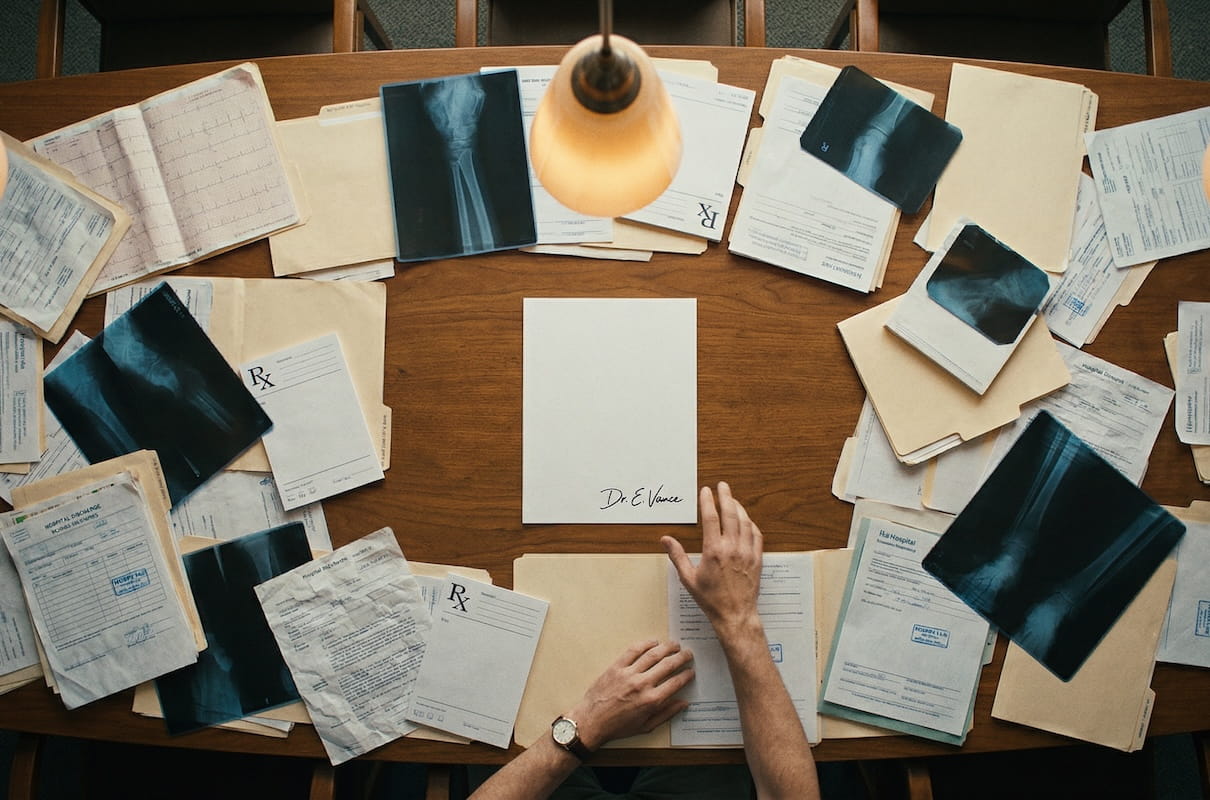
You went to the ER. You got the X-rays. You handed over a 300-page hospital file to the insurance adjuster and figured the evidence speaks for itself.
So why are they still lowballing your claim?
Raw medical records weren’t really written for insurance adjusters or juries. They were written by doctors, for other doctors. And that gap between what your chart says and what your case actually needs can cost you thousands, sometimes tens of thousands, in lost compensation.
This article breaks down the real difference between standard medical records and a medical narrative report, why one works in a legal fight, and the other usually doesn’t, and what it takes to get the document that can change your settlement.
Key Takeaways
Priority
Standard medical records are clinical shorthand written for other doctors — full of abbreviations, focused on treatment rather than legal fault, and easily exploited by insurance adjusters to dispute your injuries.
A medical narrative report is a custom letter from your doctor that establishes legal causation, connects your accident directly to your injuries, outlines future care needs, and speaks in language a jury can understand.
→ This is often the single most powerful document in a personal injury case
Narrative reports are expensive and hard to obtain on your own. Doctors charge $350 to $1,000 per hour for medico-legal work, and most won’t write one without specific legal direction from an attorney.
Insurance adjusters exploit messy records — their go-to move is cherry-picking pre-existing conditions or minor inconsistencies in your chart to devalue your claim.
→ Raw medical records make their job easy
A personal injury lawyer handles the logistics and fronts the cost of obtaining a narrative report — so you’re not paying out of pocket while you’re still recovering.
Why Do Standard Medical Records Fail in Personal Injury Cases?
Think about the last time you looked at your own medical chart. You probably couldn’t read half of it.
That’s not an exaggeration. A peer-reviewed study found that a majority of medical abbreviations weren’t recognized across user groups, and three-quarters had alternative definitions. The abbreviation “MS” alone could mean morphine sulfate, multiple sclerosis, mitral stenosis, or magnesium sulfate, depending on context. Now, think about an insurance adjuster who already doesn’t want to pay you, trying to make sense of that.
Medical records exist for one purpose: helping the next doctor treat you. They document what happened clinically and what medication you got. What the imaging showed. They don’t say “this accident caused this injury.” They don’t explain how your herniated disc will affect you for the next 30 years. They definitely don’t address who should pay for it.
And that’s exactly where adjusters pounce.
One of the most common tactics insurance companies use is searching your medical history for pre-existing conditions, then attributing your current pain entirely to those older issues. They find a note about back pain from three years ago, and suddenly, your car accident injuries are “pre-existing.” Raw records give them just enough ambiguity to run with.
Even clean records have problems. Abbreviations are used across every department, from the ER to surgery to discharge, and electronic health records can compound the issue when pre-populated data carries forward outdated information from visit to visit.
Your medical chart tells the story of your treatment. It doesn’t tell the story of your case.
What Is a Medical Narrative Report?
A medical narrative report is a formal, custom-written letter from your treating physician that does what standard records can’t. It connects the dots between the accident and your injuries in plain, legally meaningful language.
Where your ER chart might say “MVA, c/o lumbar pain, MRI ordered,” a narrative report says: “Based on my examination, treatment, and review of imaging, the patient’s lumbar disc herniation at L4-L5 was caused by the motor vehicle collision on [date], and to a reasonable degree of medical probability, this injury will require ongoing physical therapy and potential surgical intervention.”
That phrase, “reasonable degree of medical probability,” matters more than almost anything else in your case. It’s the legal standard California requires for establishing causation. Without it, your medical evidence is just information. With it, it becomes proof.
Here’s what a solid narrative report covers:
- Patient history and injury details. A chronological account of your injuries, tied directly to the accident.
- Diagnosis and treatment timeline. Every procedure, therapy session, and medication, explained in terms a non-doctor can follow.
- Causation statement. The doctor’s professional opinion regarding the accident that caused your injuries. This is the section that makes or breaks claims.
- Prognosis and future care needs. Whether you’ll need more surgery, long-term therapy, or permanent accommodations. This is how your lawyer calculates what your case is actually worth going forward.
Interestingly, even most physicians surveyed defined “reasonable certainty” as 90% or higher, when the legal standard actually means “more likely than not,” which is just over 50%. That disconnect is exactly why attorneys need to guide the process. Doctors know medicine. They don’t always know the legal weight of the words they choose.
How Do Medical Records and Narrative Reports Compare?
The simplest way to see the difference:
- Author: Medical records are written by whoever treated you (nurses, techs, physicians). A narrative report is written by your treating doctor specifically for your legal case.
- Purpose: Records document clinical care. Narrative reports establish legal causation.
- Audience: Records are for other medical professionals. Narrative reports are for adjusters, attorneys, judges, and juries.
- Language: Records use abbreviations and clinical shorthand. Narrative reports use plain English with legally required terminology.
- Cost: You pay standard copying fees for records. Narrative reports cost hundreds or thousands of dollars because you’re paying for a doctor’s time and expertise.
The bottom line: judges instruct juries to use their good sense, background, and experience when determining pain and suffering damages. A 300-page chart full of shorthand doesn’t help them do that. A clear, physician-authored letter explaining what happened to you and why. That does.
Why Can’t You Just Ask Your Doctor to Write One?
You can try. But the reality of getting a narrative report on your own is rougher than most people expect.
Doctors are busy. Writing a detailed medico-legal letter isn’t part of their normal workflow, and most aren’t excited about adding it. A narrative report means hours of additional work: reviewing your entire treatment history, drafting a formal letter, and choosing language that satisfies legal standards they may not fully understand.
Then there’s the cost. Physician expert fees average around $475 per hour across specialties, with many charging $500 to $1,000 per hour for medico-legal work. Some services offer flat rates starting around $695 for a case review and $995 for a full report. Either way, that’s a serious bill for someone already dealing with medical expenses and lost wages.
And even if your doctor agrees and you can afford it, there’s the problem of legal precision. The report needs specific phrases and must address specific legal elements. Only 37% of medical experts feel comfortable defining “reasonable degree of medical certainty” on their own. If the doctor writes “possible” instead of “probable,” the entire report can be challenged.
That’s not a knock on doctors. They went to medical school, not law school. The gap between a well-intentioned letter and a legally bulletproof narrative report is bigger than most people think.
How Does a Personal Injury Lawyer Help You Get a Narrative Report?
This is where having legal representation changes the equation entirely.
A personal injury attorney handles the full process. They identify which treating physician should write the report, draft the specific medical-legal questions the doctor needs to address, and make sure the final document uses the exact language courts require. In California, for instance, Evidence Code 801.1 now requires expert medical testimony to meet the “reasonable degree of medical probability” standard regardless of which side presents it.
The financial piece matters too. Most personal injury firms, including DK Law, front the costs of obtaining narrative reports as part of handling your case. You don’t pay out of pocket. That expense gets factored into case costs, recovered only if your case settles or wins at trial.
The insurance company has a team of people whose entire job is interpreting your medical records in whatever way costs them the least money. A narrative report, guided by an experienced attorney, levels that playing field.
How Does a Personal Injury Lawyer Help You Get a Narrative Report?
Your medical records tell the hospital what happened. A narrative report tells the insurance company, the judge, and the jury why it matters and what it’s worth.
If your claim has stalled, if an adjuster keeps pointing to “inconsistencies” in your chart, or if you’re building a case from the start, you need someone who knows how to get the right evidence in the right format.
DK Law handles the entire process, from requesting records to coordinating with your doctors. Call us today for a free case review, and let’s make sure your medical evidence actually works for you.
DK All the way


From Your Case to Compensation, we take your case all the way.
Schedule a Free Consultation
Get Expert Legal Advice at Zero Cost.
At DK Law we’re with you – all the way.
Get a Free Consultation with our experts today!

No comments:
Post a Comment