20 Most Famous & Influential Lawyers in History
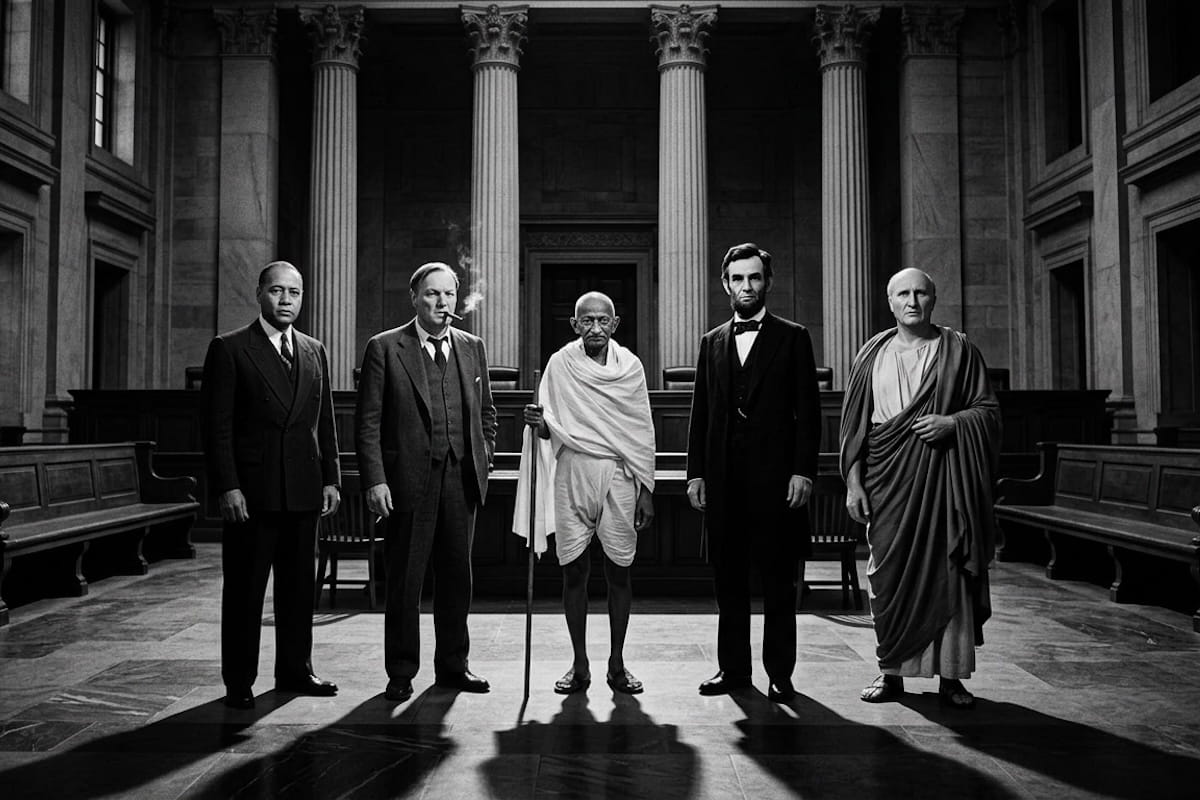
Lawyers aren’t exactly beloved and the criticism isn’t always unfair. But many of the rights and protections people rely on today were shaped through legal advocacy, case by case.
This list spans 2,400 years, five continents, and includes a Roman orator whose severed head ended up nailed to a public platform, a Frenchman who successfully defended rats in court, and a stuttering orphan who trained with pebbles in his mouth. Some of these names you’ll recognize. Others you’ve probably never heard of, and their stories are the best ones.
| # | Name | Era | Country | Known For |
|---|---|---|---|---|
| 1 | Demosthenes | 384-322 BC | Greece | Father of courtroom advocacy |
| 2 | Marcus Tullius Cicero | 106-43 BC | Rome | Most influential Western lawyer |
| 3 | John Adams | 1735-1826 | USA | Boston Massacre defense |
| 4 | Sir Edward Coke | 1552-1634 | England | Planted the seed of judicial review |
| 5 | Sir William Blackstone | 1723-1780 | England | Most influential legal textbook ever |
| 6 | Mahatma Gandhi | 1869-1948 | India/South Africa | Lawyer turned nonviolent revolutionary |
| 7 | Hortensia | 42 BC | Rome | First female legal advocate on record |
| 8 | Alexander Hamilton | 1755-1804 | USA | Press freedom and judicial review precedents |
| 9 | Abraham Lincoln | 1809-1865 | USA | 5,600 cases before the presidency |
| 10 | Daniel Webster | 1782-1852 | USA | Greatest Supreme Court advocate in U.S. history |
| 11 | Clarence Darrow | 1857-1938 | USA | Scopes Trial, Leopold and Loeb |
| 12 | Charles Hamilton Houston | 1895-1950 | USA | Architect of the strategy that killed Jim Crow |
| 13 | Thurgood Marshall | 1908-1993 | USA | Won 29 of 32 Supreme Court cases |
| 14 | Constance Baker Motley | 1921-2005 | USA | Won 9 of 10 Supreme Court cases |
| 15 | Clara Shortridge Foltz | 1849-1934 | USA | Invented the public defender system |
| 16 | Ruth Bader Ginsburg | 1933-2020 | USA | Built gender equality into constitutional law |
| 17 | Sir Thomas More | 1478-1535 | England | Patron saint of lawyers |
| 18 | Nelson Mandela | 1918-2013 | South Africa | South Africa’s first Black law firm |
| 19 | B.R. Ambedkar | 1891-1956 | India | “Untouchable” who wrote India’s constitution |
| 20 | Gerry Spence | 1929-2025 | USA | Never lost a criminal case in 55+ years |
1. Demosthenes (384-322 BC, Greece)
Known for: The founding figure of courtroom advocacy. Orphaned at seven, he sued his own guardians at age 20 and launched the Western tradition of legal argument.
Most lawyers can trace their professional lineage, in some indirect way, back to this guy. Ancient Athens had no professional attorneys, but Demosthenes turned courtroom speech into a craft that others studied and copied for centuries.
His father died when he was seven. His guardians stole his inheritance. So at 20, he hauled them into court and argued his own case. He won, though he only recovered a fraction of what was owed, and the experience turned him into Athens’ most sought-after legal mind.
The speech impediment detail is the one everyone knows: he practiced with pebbles in his mouth while running uphill. Plutarch reported this, and whether or not it happened exactly that way, Cicero and Quintilian both considered him the greatest orator of antiquity. His defense of Ctesiphon in On the Crown remains required reading in rhetoric courses. He took his own life by poison rather than face capture by Alexander the Great’s successors.
2. Marcus Tullius Cicero (106-43 BC, Rome)
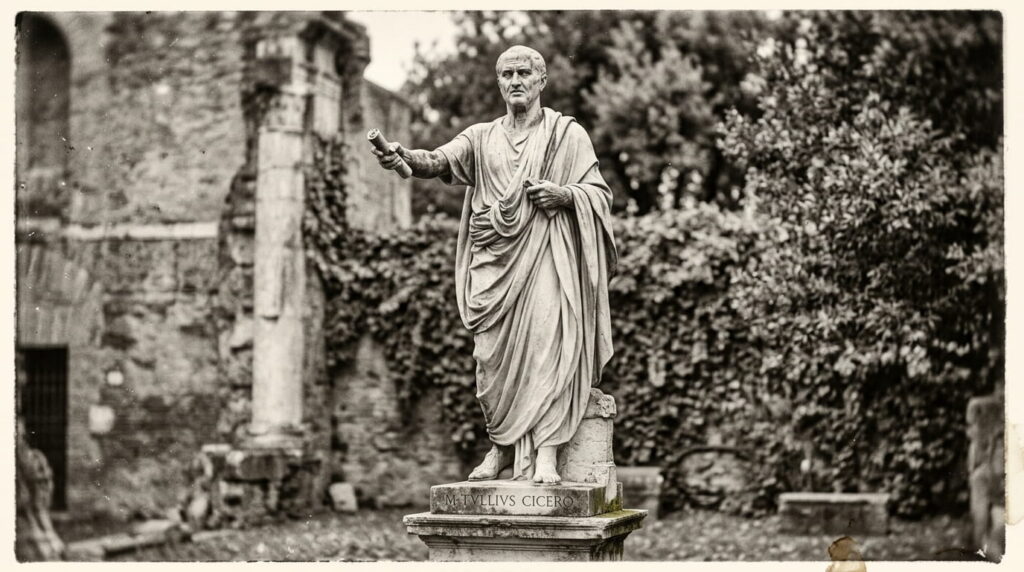
Known for: The most influential lawyer in Western civilization. His legal philosophy shaped the American Constitution, and his courtroom speeches are still studied by trial attorneys today.
His name means “chickpea.” Advisors told him to change it. He refused, saying he’d make it more famous than any other. He did.
Cicero was a practicing courtroom advocate for decades in Rome, winning his first major case by defending Sextus Roscius on a fabricated murder charge. The real killers had connections to the dictator Sulla, so taking the case could have gotten Cicero killed.
What separates Cicero from every other ancient figure is reach. His identification of law with “right reason” and natural rights directly influenced John Locke, who influenced Thomas Jefferson, who wrote the Declaration of Independence. John Adams studied Cicero obsessively. The University of Baltimore Law School has documented how deeply Cicero’s thinking runs through modern legal and political philosophy.
3. John Adams (1735-1826, USA)
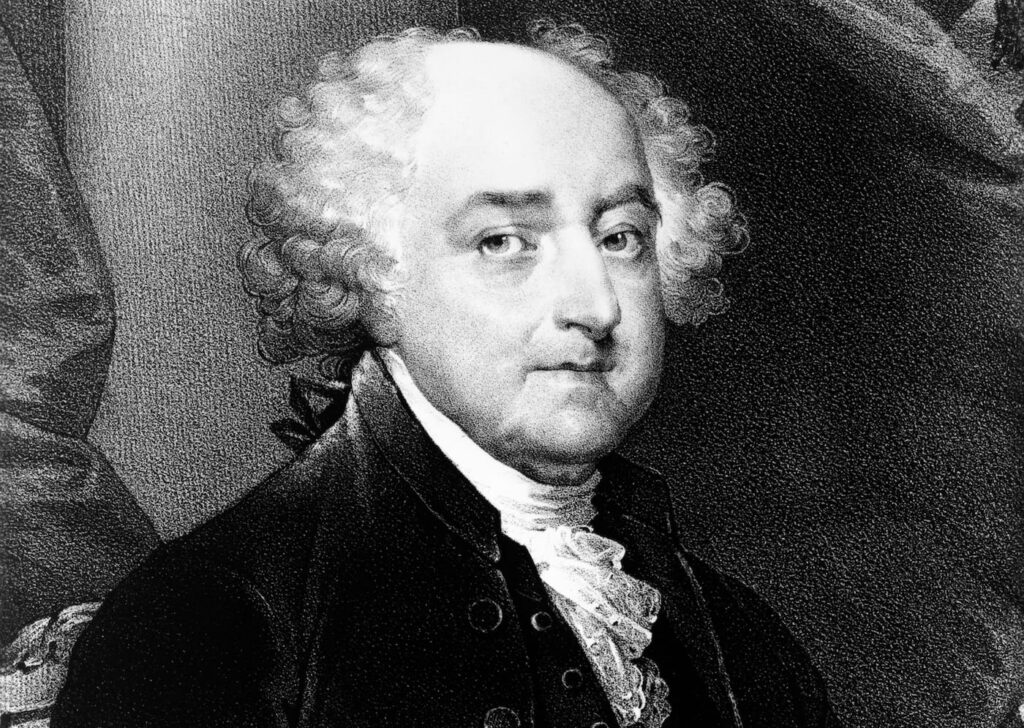
Known for: Defending the British soldiers charged with murder in the Boston Massacre (1770) when no other attorney would take the case. He won an acquittal for six and had charges reduced for two.
Adams was 34 and had a growing law practice in Boston. Taking this case was professional suicide on paper. British soldiers had fired into a crowd of colonists, killing five. The city wanted blood. Adams took the defense anyway and later called it “one of the best pieces of service I ever rendered my country.”
His closing argument produced one of the most quoted lines in American legal history: “Facts are stubborn things; and whatever may be our wishes, our inclinations, or the dictates of our passions, they cannot alter the state of facts and evidence.” Far from ending his career, the defense made him more popular than ever. He was elected to the Massachusetts House three months after the trial.
4. Sir Edward Coke (1552-1634, England)
Known for: The most influential common-law jurist in English history and the intellectual bridge between the Magna Carta and the U.S. Constitution.
Coke’s declaration in Dr. Bonham’s Case (1610) that courts could void an unjust Act of Parliament planted the seed of judicial review, the principle that makes the Supreme Court the Supreme Court. James Otis cited Coke when arguing against British Writs of Assistance in 1761, one of the legal sparks that lit the American Revolution.
As Attorney General, he prosecuted Sir Walter Raleigh with legendary brutality. He married his second wife in a questionable ceremony largely to beat his rival Francis Bacon (who was courting the same woman). He told King James I to his face that even a king was subject to the law. His four-volume Institutes was required reading for American lawyers through the 19th century, and his influence on the common-law tradition is difficult to overstate.
5. Sir William Blackstone (1723-1780, England)

Known for: Author of the Commentaries on the Laws of England, the most influential legal textbook in the English-speaking world. He was the first person to teach common law at any university.
Blackstone became Oxford’s first Vinerian Professor partly because his barrister practice was failing. History’s most successful career pivot. His Commentaries earned him roughly £14,000 (about £2 million in today’s money), and the American colonies bought nearly as many copies as England itself.
Abraham Lincoln studied Blackstone by candlelight. So did generations of frontier lawyers who had no access to law schools or legal libraries. One scholar wrote that without the Commentaries, it’s doubtful the United States would have so widely adopted the common law.
The irony is that Blackstone contradicted his predecessor Coke on judicial review, championing Parliamentary sovereignty instead. Both views fed into the American constitutional debate, with the Founders picking and choosing from each.
6. Mahatma Gandhi (1869-1948, India/South Africa)
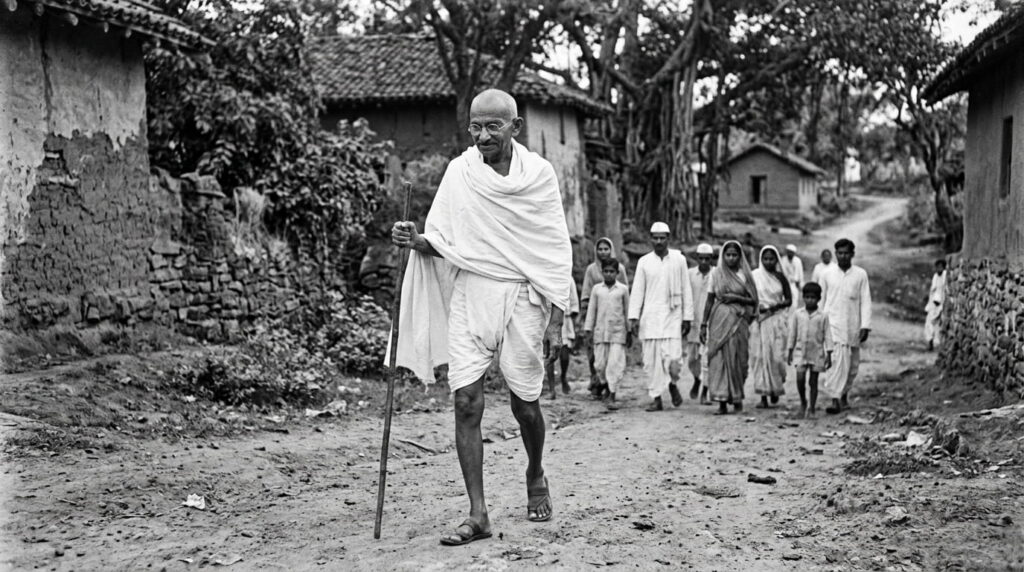
Known for: Twenty-plus years as a practicing lawyer before becoming a full-time activist. Most people don’t realize that Gandhi’s legal career directly shaped his approach to nonviolent resistance.
Gandhi was called to the bar at London’s Inner Temple in 1891 and became the first Indian lawyer to practice in South Africa, where he built a flourishing firm. His legal training, particularly his commitment to truth in advocacy, became the philosophical backbone of Satyagraha.
Early on, he was so paralyzed by stage fright that he literally fled a courtroom mid-trial and returned his fee. He later developed a reputation for absolute honesty with clients, once scolding his own client and asking the court to dismiss the case when he discovered the client had been dishonest. The Inner Temple disbarred him in 1922 after his imprisonment by British authorities. His name was posthumously restored in 1984 with a special portrait unveiled in the Inn’s library.
7. Hortensia (42 BC, Rome)
Known for: The first documented female legal advocate in Western history. She argued a tax case before the Roman triumvirs and won, making a “no taxation without representation” argument roughly 1,800 years before the American Revolution.
When Rome’s three most powerful men imposed a special tax on 1,400 wealthy women to fund their civil war, the women first went to the wives of the triumvirs for help. Fulvia, wife of Mark Antony, threw them out. So Hortensia, daughter of Cicero’s greatest courtroom rival Quintus Hortensius, marched into the Roman Forum and argued the case herself.
Her argument was simple and devastating: why should women pay for a war they had no say in starting? The triumvirs tried to have her removed by force, but the crowd’s outcry stopped the soldiers. The tax was reduced from 1,400 women to 400, and men were taxed to cover the rest.
The bitter footnote: her advocacy was so effective that the triumvirs later banned women from representing others in court. That prohibition stuck around for centuries.
8. Alexander Hamilton (1755-1804, USA)
Known for: Becoming New York City’s preeminent attorney after studying law for only six months. His cases established early precedents for judicial review and press freedom.
Rutgers v. Waddington (1784) foreshadowed the concept of judicial review a full 19 years before Marbury v. Madison made it official. People v. Croswell established press-freedom principles that still matter. He wrote a legal manual at 25 that became standard practice in New York for decades and defended unpopular Loyalists after the Revolution, when doing so took real courage.
Three of his surviving four sons became attorneys themselves. The tragic part: New York City’s leading legal mind died in a duel with Aaron Burr rather than trusting the legal system he’d spent his career building.
9. Abraham Lincoln (1809-1865, USA)

Known for: A self-taught frontier lawyer who handled over 5,600 cases in a 25-year legal career before becoming the 16th president.
Lincoln learned law from a borrowed copy of Blackstone’s Commentaries (number 6 on this list, full circle). He became one of Illinois’ most distinguished trial lawyers with an almost uncanny ability to simplify complex matters through stories and parables.
The famous “Almanac Trial” of 1858 shows his courtroom instincts at their sharpest. A murder defendant’s fate hinged on an eyewitness who claimed he saw the killing by moonlight. Lincoln pulled out a farmer’s almanac and proved it had been a new moon that night. No moonlight. Acquittal.
His filing system reportedly involved stuffing papers into his stovepipe hat. He rode the circuit on horseback twice a year to county courthouses across Illinois, building the political network that eventually put him in the White House. He planned to return to his law practice after the presidency.
10. Daniel Webster (1782-1852, USA)
Known for: By nearly universal agreement, the greatest Supreme Court advocate in American history. He argued roughly 223 cases before the Court, more than any other lawyer of his era.
Former Solicitor General Seth Waxman described Webster’s status among Supreme Court advocates by comparing him to Zeus in the Pantheon. Not a resident. The ruler.
His four-hour argument in Dartmouth College v. Woodward (1819) reportedly left most of the courtroom, including the justices, in tears. The case established that corporate charters are constitutionally protected contracts, a principle that shaped American business law for two centuries. His famous closing: “It is, Sir, as I have said, a small college. And yet there are those who love it!” He also shaped McCulloch v. Maryland (federal supremacy) and Gibbons v. Ogden (interstate commerce). Chief Justice John Marshall relied heavily on Webster’s arguments when crafting those landmark opinions.
11. Clarence Darrow (1857-1938, USA)

Known for: The greatest criminal defense attorney of the early 20th century. His career reads like a highlight reel of American legal history: the Leopold and Loeb case, the Scopes “Monkey Trial,” and the Ossian Sweet defense.
Darrow attended law school for only one year. He quit a lucrative position as attorney for the Chicago and North Western Railway to represent Eugene Debs during the Pullman Strike, trading comfort for conviction. His defense of Dr. Ossian Sweet (1926), a Black man who shot into a white mob attacking his newly purchased home in a white neighborhood, produced an acquittal that resonated for decades.
The Scopes Trial made him a household name, but the Leopold and Loeb case showed his skill at its peak. Two wealthy teenagers murdered a 14-year-old boy for the thrill of it. Darrow’s 12-hour closing argument against the death penalty, delivered over two days, is still taught in law schools.
Before his death, he declared that if there was an afterlife, he’d return as a ghost on a specific Chicago bridge on the anniversary of his passing. People still show up.
12. Charles Hamilton Houston (1895-1950, USA)

Known for: The architect of the legal strategy that dismantled Jim Crow. Known as “The Man Who Killed Jim Crow,” he mentored Thurgood Marshall and devised the NAACP’s entire litigation blueprint for ending segregation.
Most people know Thurgood Marshall (coming up next). Almost nobody knows the man who made Marshall possible. Houston served as NAACP special counsel and dean of Howard Law School, where he turned a struggling night school into a training ground for civil rights litigators. His strategy was patient and surgical: force states to actually provide “equal” facilities under “separate but equal,” making segregation so expensive that the system would collapse under its own weight.
He was the first Black student on the Harvard Law Review. His experience with racism in the segregated WWI Army drove him to law. Students at Howard called him “Iron Shoes and Cement Pants” for his relentless standards. He carried a movie camera through the rural South, personally filming crumbling “separate but equal” schools to use as evidence, pioneering the use of visual documentation in civil rights litigation.
Marshall once said, “We wouldn’t have been anyplace if Charlie hadn’t laid the groundwork for it.” Houston died of a heart attack in 1950, four years before Brown v. Board of Education vindicated everything he’d built. Five Supreme Court justices attended his funeral.
13. Thurgood Marshall (1908-1993, USA)
Known for: The most consequential civil rights litigator in American history. As NAACP Legal Defense Fund chief counsel, he argued 32 cases before the Supreme Court and won 29, including Brown v. Board of Education (1954).
Marshall was rejected from the University of Maryland Law School because of his race. He later successfully sued that same school to force it to admit Black students. That case, Murray v. Pearson (1936), was one of the first in Houston’s long-game strategy.
Over 25 years as chief counsel, Marshall personally dismantled the legal scaffolding of segregation, case by case. Shelley v. Kraemer struck down racially restrictive housing covenants. Smith v. Allwright ended white-only primaries. Sweatt v. Painter integrated graduate schools.
He traveled the rural South gathering evidence at serious personal risk from white supremacists. Brown v. Board was the culmination of decades of methodical litigation, not a single flash of brilliance. He became the first Black Supreme Court justice in 1967, but his work as an advocate is the reason he’s on this list.
14. Constance Baker Motley (1921-2005, USA)
Known for: The first Black woman to argue before the Supreme Court, where she argued 10 cases and won nine. She wrote the original complaint in Brown v. Board of Education.
As lead trial attorney for the NAACP Legal Defense Fund for over two decades, Motley personally desegregated universities across the Deep South. She represented James Meredith in integrating Ole Miss. She represented Charlayne Hunter-Gault at the University of Georgia. She represented Vivian Malone in the famous “Stand in the Schoolhouse Door” confrontation with Governor George Wallace.
She drove through KKK territory to argue cases and spent nights under armed guard with Medgar Evers. Later, as a federal judge, she decided Ludtke v. Kuhn, ruling that female sports reporters must have equal locker-room access and telling athletes to wear towels. Ruth Bader Ginsburg eulogized her. Justice Ketanji Brown Jackson has cited Motley as a direct inspiration.
15. Clara Shortridge Foltz (1849-1934, USA)
Known for: California’s first female lawyer, a single mother of five who taught herself law and invented the public defender system.
Foltz didn’t just break into the legal profession. She had to rewrite California law to get through the door. The state’s statutes limited law practice to “white male citizens,” so she drafted and lobbied through the “Woman Lawyer Bill,” changing the requirement to “any citizen.” She was admitted to the bar in 1878.
She then sued Hastings College of Law for denying her admission because of her gender. And won.
Her biggest contribution is one most people don’t know about: the public defender. Her “Foltz Public Defender Bill” became the blueprint for public defender offices adopted across more than 30 states. Los Angeles County established the nation’s first public defender office in 1913 based on her model.
16. Ruth Bader Ginsburg (1933-2020, USA)
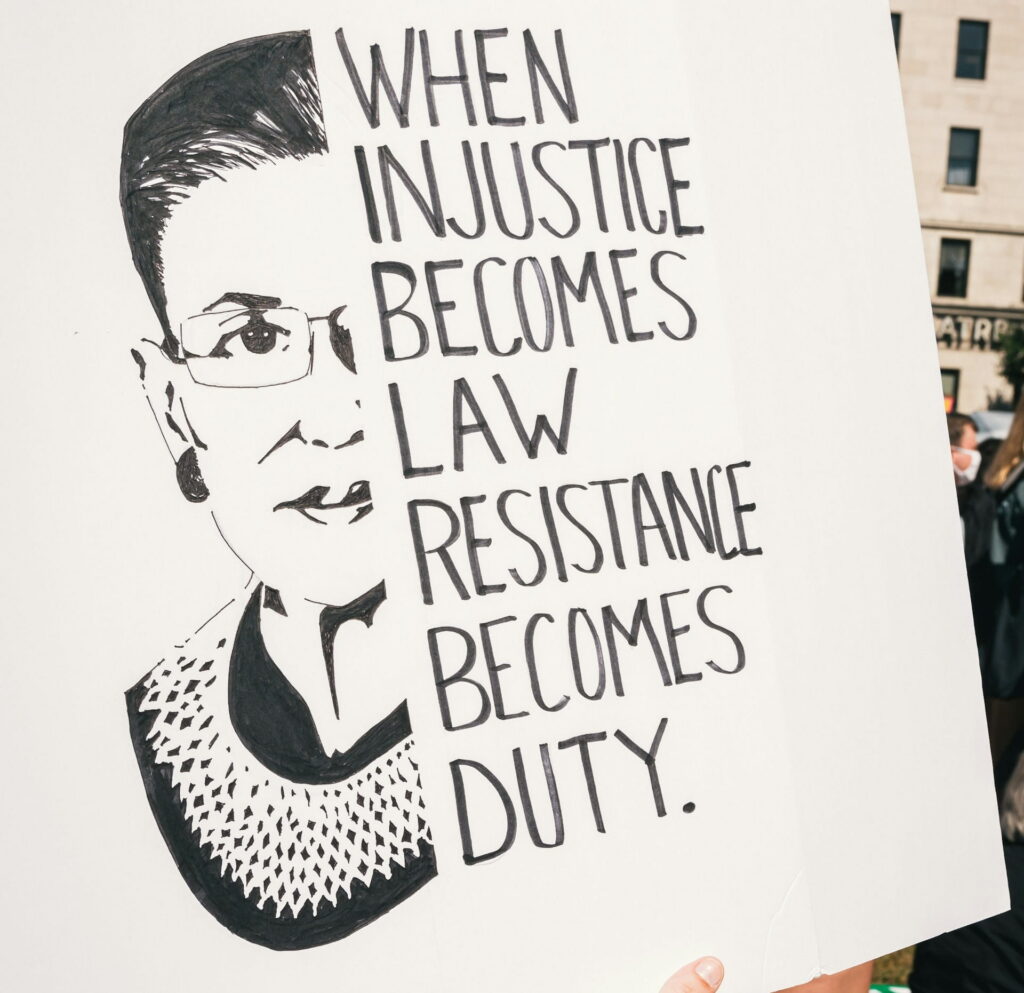
Known for: The architect of gender equality as a constitutional principle. Before becoming a Supreme Court justice, she argued six landmark gender-discrimination cases before the Court and won five.
Ginsburg was one of only nine women in a Harvard Law class of over 500. She graduated at the top of her class at Columbia, but couldn’t get hired by any New York law firm because she was a woman. She co-founded the ACLU Women’s Rights Project and has been called the Thurgood Marshall of the women’s rights movement, using the same incremental litigation strategy to chip away at gender-based legal distinctions.
One strategic decision stands out. She deliberately chose a male plaintiff in Weinberger v. Wiesenfeld (1975) to demonstrate that gender discrimination hurts everyone, not just women. She also started using “gender” instead of “sex” in her briefs after her secretary pointed out that the word “sex” kept distracting the justices.
17. Sir Thomas More (1478-1535, England)
Known for: A highly successful barrister who rose to the position of Lord Chancellor of England and was later executed for refusing to endorse Henry VIII’s break from Rome. He is the patron saint of lawyers and statesmen.
A 1999 poll of British legal professionals named More the person who most embodies the virtues of the law. His equity court reforms permanently shaped English legal procedure. He coined the word “Utopia.” He insisted on educating his three daughters to the same level as his son, which was striking for the 1500s.
His trial on perjured testimony and his execution remain among the most dramatic moments in legal history. His last words: “I die the king’s good servant, but God’s first.” Robert Bolt’s A Man for All Seasons keeps the story alive in the cultural imagination.
18. Nelson Mandela (1918-2013, South Africa)
Known for: Opening South Africa’s first Black-run law firm in 1952, which was immediately flooded with clients seeking help against apartheid laws.
Mandela & Tambo operated in Johannesburg and were, by Mandela’s own account, always overwhelmed with cases. He described himself as “rather flamboyant in court,” saying he didn’t act as if he were a Black man in a white man’s court but as if everyone else was a guest in his.
The Transvaal Law Society tried to have him struck from the roll, but the effort failed on the argument that political offenses differ from crimes of moral turpitude. He represented himself at his 1962 trial and delivered his famous “I am prepared to die” speech at the Rivonia Trial (with a crucial edit suggested by his lawyer George Bizos, who added the words “if needs be” before “I am prepared to die,” possibly saving Mandela from the death penalty).
19. B.R. Ambedkar (1891-1956, India)
Known for: Born into the “untouchable” Mahar caste, he overcame extreme caste discrimination to become the principal architect of the Constitution of India, one of the world’s longest and most detailed constitutions, which abolished untouchability for over a billion people.
As a child, Ambedkar was forbidden from drinking from the school water tap. He earned doctorates from Columbia University and the London School of Economics, trained as a barrister at Gray’s Inn in London, and practiced law for two decades. He successfully defended trade union leaders by finding loopholes in the Trade Disputes Act. He was offered the position of Chief Justice of Hyderabad State, but turned it down to keep serving his people.
His legal practice directly informed his constitutional drafting. The document he produced guaranteed fundamental rights, prohibited caste-based discrimination, and created affirmative action protections for historically marginalized communities. Shortly before his death in 1956, he converted to Buddhism along with hundreds of thousands of followers, rejecting the caste system that had defined his childhood.
20. Gerry Spence (1929-2025, USA)
Known for: Possibly the most successful trial lawyer in American history by win rate. He never lost a criminal case and hadn’t lost a civil case since 1969, a streak spanning over 55 years.
Spence started his career on the wrong side, at least by his own telling. He spent 18 years defending corporations before switching to plaintiff work, calling it a moral awakening. The switch paid off for his clients in ways that are hard to overstate.
He represented the Karen Silkwood family against nuclear giant Kerr-McGee and won $10.5 million (the case later became a Meryl Streep film). He defended Randy Weaver at Ruby Ridge and won an acquittal. He secured an acquittal for Imelda Marcos on fraud and racketeering charges that the government considered a slam dunk. He won a $52 million verdict against McDonald’s in a separate case from the famous coffee lawsuit everyone already knows about.
Honorable Mentions
- Raphael Lemkin (1900-1959, Poland/USA): The Polish-Jewish prosecutor who coined the word “genocide” in 1944 and campaigned single-handedly for the UN Genocide Convention. He lost 49 family members in the Holocaust and died in poverty in a New York apartment. Only a handful of people came to his funeral.
- Hugo Grotius (1583-1645, Netherlands): The “father of international law” who entered university at 11 and earned his doctorate at 15. His wife smuggled him out of prison hidden inside a chest of books.
- George Bizos (1927-2020, Greece/South Africa): Nelson Mandela’s defense attorney for six decades. At 13, Bizos and his father helped seven Allied soldiers escape Nazi-occupied Greece in a fishing boat. He suggested Mandela add “if needs be” before “I am prepared to die,” a two-word edit that may have prevented a death sentence.
- Johnnie Cochran (1937-2005, USA): Led the “Dream Team” defense in the O.J. Simpson trial. His closing argument and the phrase “If it doesn’t fit, you must acquit” became the most recognizable courtroom moment in television history.
- Bryan Stevenson (b. 1959, USA): Founder of the Equal Justice Initiative and the lawyer behind Miller v. Alabama, which banned mandatory life-without-parole sentences for juveniles. His book Just Mercy was adapted into a film starring Michael B. Jordan.
- Pauli Murray (1910-1985, USA): Legal scholar whose work shaped both Brown v. Board and Reed v. Reed. She coined “Jane Crow” to describe the intersection of race and gender discrimination decades before the concept had a mainstream name.
- Belva Lockwood (1830-1917, USA): First woman to argue before the U.S. Supreme Court. She ran for president twice before women could vote and won a $5 million judgment for the Cherokee Nation at age 76.
The Thread That Connects Them All
What connects a Greek orphan practicing with pebbles in his mouth to a California single mother rewriting state law so she could practice? Or a Roman woman arguing tax policy in the Forum to a South African freedom fighter running a law firm under apartheid?
Every person on this list used the law to shift power. Sometimes toward themselves, sure. But mostly toward people who had none. Demosthenes fought for his stolen inheritance. Houston and Marshall dismantled an entire system of racial segregation through methodical, grinding, often dangerous legal work. Foltz created the public defender system so that being poor didn’t mean being defenseless. Ambedkar wrote a constitution that gave rights to hundreds of millions of people who’d been told they were less than human.
The law is only as strong as the people willing to use it. And when you need someone in your corner fighting for what’s right, the tradition these 20 people built is what makes that possible.
If you’ve been injured and need legal guidance, the team at DK Law offers free consultations to help you understand your rights and options.
DK All the way


From Your Case to Compensation, we take your case all the way.
Schedule a Free Consultation
Get Expert Legal Advice at Zero Cost.
At DK Law we’re with you – all the way.
Get a Free Consultation with our experts today!

No comments:
Post a Comment