What Happens If There’s a Car Accident and No One Else Is Involved?
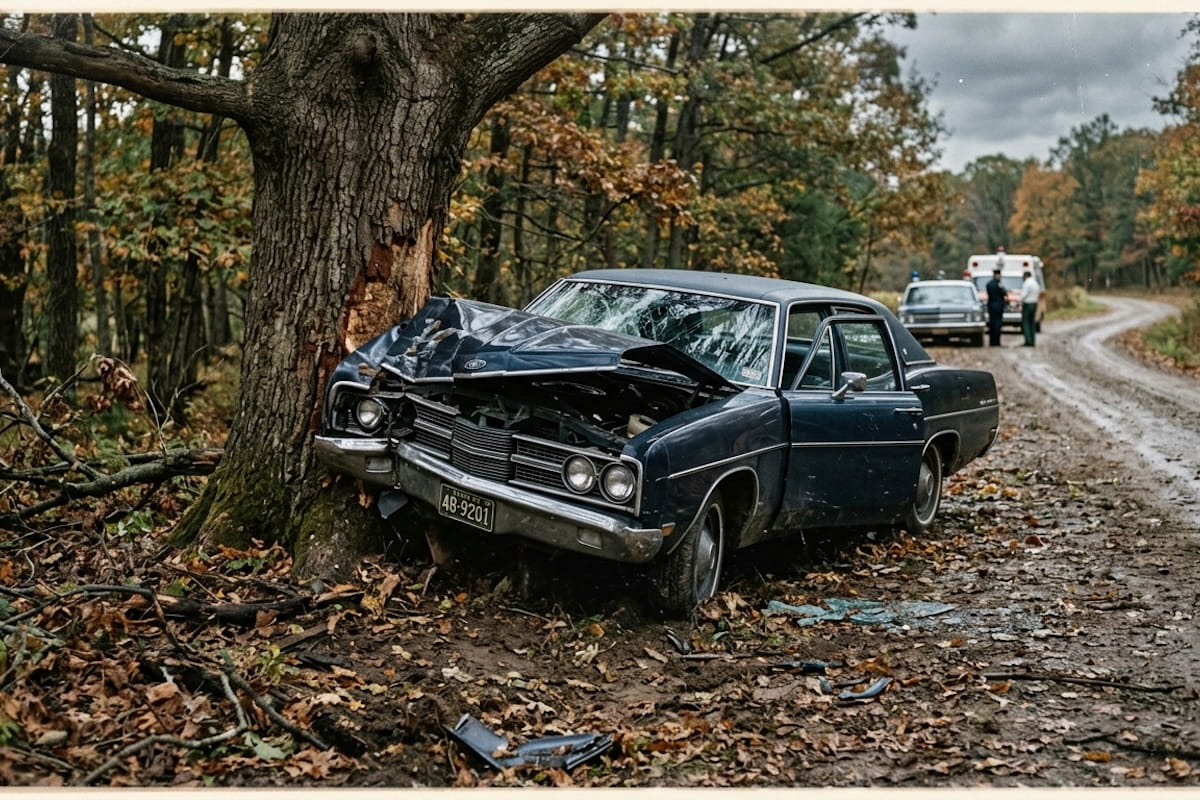
If you’re the only vehicle in the crash, you’re generally presumed at fault. Your collision insurance covers the damage (minus your deductible), and your legal obligations depend on how much damage occurred and which state you’re in. No other driver means no other driver’s insurance to claim against. The financial weight falls on your own policy.
One thing worth clearing up right away: “no one else involved” and “no-fault state” are two completely different concepts. No-fault refers to states that require PIP insurance, where each driver’s own policy pays regardless of who caused a crash. California is not a no-fault state. It runs a fault-based tort system. So if you ran off the road and hit a guardrail in California, you’re dealing with your own collision coverage and California’s reporting laws, not some PIP framework.
Key Takeaways
Priority
Single-vehicle crashes account for 52% of all motor vehicle crash deaths nationally. These are not rare events.
Insurers treat single-vehicle accidents as at-fault by default. Expect a 20–50% premium increase in California, lasting about three years — and California does not allow accident forgiveness programs.
If property damage exceeds $1,000 or anyone is injured, California law requires you to file an SR-1 report with the DMV within 10 days. Failure to file can result in license suspension.
→ Miss the deadline, lose your license
A third party — Caltrans, a vehicle manufacturer, or an unidentified phantom driver — may share liability even in a single-vehicle crash. Government claims against a public entity have a six-month filing deadline.
→ That’s half the normal window — don’t wait
Are You Automatically At Fault in a Single-Vehicle Accident?
From an insurance standpoint, yes. When there’s no other vehicle and no external force caused the crash, the insurer looks at one driver and one set of circumstances. You were behind the wheel. The road didn’t jump in front of you (although sometimes, as we’ll get to, the road itself is the problem).
This means the claim goes through your collision coverage, which pays for damage to your vehicle regardless of fault, but you pay the deductible first. If you only carry liability insurance, you’re out of luck. Liability covers damage you cause to other people and their property. In a solo crash with no other parties, there’s nothing for liability to pay.
Worth knowing the difference: if a deer runs into your car, that’s a comprehensive claim. Different coverage, different deductible, and it typically doesn’t count as an at-fault incident on your record. But if you swerve to avoid the deer and slam into a telephone pole, that’s a collision. The swerve made it your vehicle, striking an object.
Should You File a Claim or Pay Out of Pocket?
This is where the math matters more than the instinct. Filing a collision claim after a single-car accident will likely raise your California premiums 20% to 50%, and that increase sticks for roughly three years. Industry data puts the national average increase at around 43% to 48% for a single at-fault accident.
California makes this calculation worse than most states because insurers here cannot offer accident forgiveness. Proposition 103 prohibits it. Your first at-fault claim gets surcharged just like your third.
So if your deductible is $1,000 and repairs cost $1,400, you’re collecting $400 from insurance while potentially paying thousands more in premiums over the next three years. A rough rule: if the repair estimate is within about $500 to $1,000 of your deductible, paying out of pocket probably saves you money in the long term.
Do You Have to Report a Single-Car Accident in California?
Most states require accident reports when damage or injuries reach a certain threshold. In California, the trigger is low.
California Vehicle Code § 16000 requires every driver involved in an accident to file an SR-1 report with the DMV within 10 calendar days if property damage to any one person exceeds $1,000, anyone is injured (any severity), or anyone is killed. That $1,000 threshold catches almost every real-world collision. A cracked bumper cover alone can run $800 to $1,200 in parts and labor.
The SR-1 is separate from a police report and from your insurance claim. Your insurer does not file it for you in most cases. The obligation sits with the driver.
What Happens If You Don’t File?
Vehicle Code § 16004 authorizes the DMV to suspend your driver’s license until the SR-1 is filed. Driving on a suspended license is a misdemeanor. And if you later try to file an insurance claim or pursue any legal action related to the accident, the missing SR-1 creates complications.
Filing doesn’t mean you’re admitting fault. The DMV doesn’t determine fault. It’s a factual report of the incident. But inaccuracies on the form can be used against you later, so be precise with details and don’t speculate about causes.
When Might Someone Else Be Responsible for a Single-Vehicle Crash?
You hit a guardrail, and your car is the only one involved. Seems straightforward. But three scenarios can shift fault away from you, partially or entirely.
Did a Dangerous Road Condition Cause the Crash?
A pothole that swallowed your tire. A curve with no warning sign. Faded lane markings that disappeared in the rain. Missing guardrails on a drop-off.
California Government Code § 835 holds public entities (Caltrans, cities, and counties) liable for dangerous conditions of their property. You have to prove four things: the dangerous condition existed when you were injured, it caused the crash, it created a foreseeable risk of the kind of injury you suffered, and the agency either created the condition through negligence or knew about it (or should have known) and failed to fix it.
The timeline is compressed. Under Government Code § 911.2, you must file a formal government tort claim within six months of the accident. Not two years. Six months. Miss that window and the claim is almost certainly gone, regardless of how obvious the road defect was. This catches people off guard because California’s standard personal injury statute of limitations is 2 years, and they assume they have that long for every claim.
Did a Vehicle Defect Cause the Crash?
Brake failure, tire blowout, steering malfunction, sudden acceleration. If a mechanical defect caused you to lose control, the manufacturer or parts supplier may be liable under California’s strict product liability rules. You don’t need to prove negligence, only that the product was defective and the defect caused the accident.
Preserve the vehicle. Don’t authorize repairs or disposal until the defect theory has been evaluated. The physical evidence is the case.
Did a Phantom Vehicle Force You Off the Road?
Another car cuts you off, you swerve, you hit the median, and they keep driving. You’re the only car at the scene, but you’re not the only driver responsible.California’s uninsured motorist coverage under Insurance Code § 11580.2 may apply to phantom vehicle scenarios.
But there’s a catch: you generally need corroboration that another vehicle was involved. Physical contact evidence or an independent witness. Your word alone, without supporting proof, may not be enough to trigger UM coverage for an unidentified vehicle.
What Should You Do Right After a Single-Car Accident?
Stay at the scene if you’ve damaged any property that isn’t yours (guardrails, fences, signs, utility poles). Leaving without reporting can expose you to hit-and-run liability under Vehicle Code § 20002, even if no one else was physically present.
Document everything. Photograph the vehicle damage, the road conditions, any skid marks, signage (or lack of it), and the surrounding area. Get a repair estimate before deciding whether to file a claim. File the SR-1 with the DMV within 10 days if the damage exceeds $1,000 or if you’re injured.
If you suspect a road defect or vehicle malfunction contributed to the crash, talk to an attorney before giving a recorded statement to your insurer. The six-month government claim deadline is tight, and the wrong statement early on can undermine a third-party liability case later.
Frequently Asked Questions
Can a single-car accident be nobody’s fault?
Yes. If a mechanical defect, a road hazard, or another driver’s actions caused the crash, you may not be at fault at all. California’s pure comparative negligence system allows you to recover damages proportional to the other party’s fault, even if you share some responsibility.
Will my insurance go up after a single-car accident?
Almost certainly, if you file a collision claim. California drivers typically see 20% to 50% premium increases that last about 3 years. Since California prohibits accident forgiveness, even a first offense affects your rate.
Do I have to call the police if no one was hurt?
California doesn’t strictly require a police report for property-damage-only accidents. But a police report creates an official record that supports both your insurance claim and any SR-1 filing. If damage is significant, calling is the safer move.
Why should you never admit fault at the scene?
Your initial assessment might be wrong. Road conditions you didn’t notice, a vehicle defect you couldn’t see, or a phantom vehicle scenario could shift liability. Stick to the facts when talking to the police and your insurer. Save the analysis for later.
Hit a guardrail, slid off the road, or struck a fixed object in California? A third party may share responsibility. Contact DK Law for a free consultation to evaluate whether a road defect, vehicle malfunction, or phantom driver contributed to your crash.
DK All the way


From Your Case to Compensation, we take your case all the way.
Schedule a Free Consultation
Get Expert Legal Advice at Zero Cost.
At DK Law we’re with you – all the way.
Get a Free Consultation with our experts today!

No comments:
Post a Comment