What Is a Reservation of Rights Letter and What It Means for Your California Claim
A reservation of rights letter is a formal written notice from an insurance company to its policyholder. It says the insurer will investigate a claim, and may even provide a legal defense, but reserves the right to deny coverage later based on policy exclusions or other conditions. It is not a denial. The insurer is accepting the claim conditionally while keeping the door open to walk away from the bill if the investigation gives them a reason to.
Key Takeaways
Priority
A reservation of rights letter means the insurer is investigating your claim but hasn’t denied it — coverage may not apply depending on what they find.
California law requires insurers to defend you even while they question coverage. Under the Montrose standard, the duty to defend kicks in whenever there is even a remote possibility your policy applies.
→ A reservation doesn’t let your insurer walk away from your defense
If the insurer’s reservation creates a conflict of interest, you may be entitled to independent “Cumis” counsel at the insurer’s expense under California Civil Code § 2860.
How you respond to this letter can directly affect whether your coverage survives. Do not ignore it.
→ Silence can be treated as non-cooperation — respond promptly
What Does a Reservation of Rights Letter Actually Mean?
In plain terms: we received your claim, we’re going to investigate (and possibly defend you in a lawsuit), but we’re not promising to pay. The insurer is preserving its ability to deny coverage later if the investigation turns up a policy exclusion, a lapse, or some other basis to walk away.
Think of it as a conditional yes. The insurer shows up, assigns defense counsel, and starts working the case. But the letter plants a flag. Without it, an insurer that begins defending a claim could be prevented from later denying coverage under California’s waiver-by-conduct doctrine. So the letter protects the insurer. Not you.
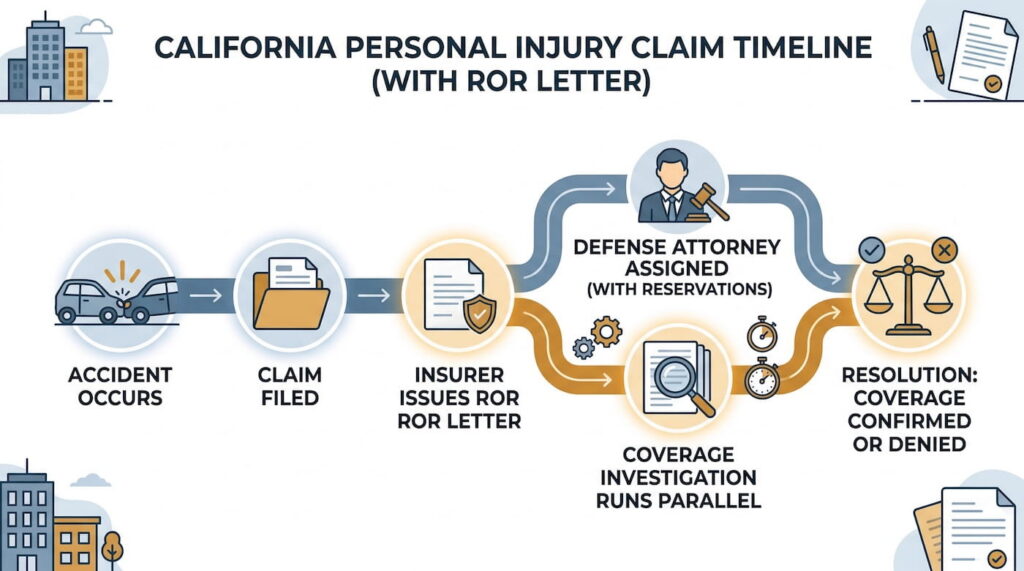
Who’s Involved in a Reservation of Rights Situation?
Three parties, three different interests:
- The insurer sends the ROR letter and controls the defense. Their goal is to minimize financial exposure, which means they’re simultaneously defending the policyholder and investigating whether they can avoid paying altogether.
- The policyholder (insured) is the person or business being sued. They tendered the claim, expecting full defense and coverage. The ROR letter tells them that the second part is now in question.
- The third-party claimant is the injured person filing suit. They want damages, ideally backed by the insurer’s resources. The insurer has no duty to communicate coverage positions to the claimant directly.
The conflict between these parties is baked in. In a car accident lawsuit alleging both negligent and intentional conduct, the insurer might benefit from proving the insured acted intentionally, because intentional acts are excluded from most policies. Your own insurance company could have a financial incentive to prove something that kills your coverage.
California recognized how dangerous this arrangement is. Under Civil Code § 2860, when an insurer’s reservation creates a genuine conflict, the insured can select independent counsel (called “Cumis” counsel) and the insurer has to foot the bill. The conflict has to be real, not theoretical.
What Are the Most Common Reasons Insurers Send This Letter?
Insurers issue ROR letters when coverage is genuinely uncertain. The triggers vary, but these come up repeatedly:
- Coverage exclusions that might apply, such as intentional acts, business pursuits, or assault and battery
- Late reporting, where the policyholder’s delay in notifying the insurer may have prejudiced the investigation
- Policy lapses or gaps, where the incident might fall outside the active coverage period
- Disputed facts about whether the event qualifies as an “occurrence” under the policy
- Limits issues, where claimed damages exceed the policy or aggregate limits are already partially exhausted
Getting this letter does not mean the insurer found a reason to deny. It means they found a reason to look closer.
What Can an Insurer Do (and Not Do) Under California Law?
California offers some of the strongest policyholder protections in the country. Under Montrose Chemical Corp. v. Superior Court (1993), the duty to defend is far broader than the duty to indemnify. The insurer must provide a defense unless the allegations “can by no conceivable theory” trigger coverage. Any ambiguity gets resolved in the insured’s favor.
Insurers also have to follow California’s Fair Claims Settlement Practices Regulations. Acknowledge the claim within 15 days. Accept or deny coverage within 40 days of receiving proof of claim. Written updates every 30 days if the investigation runs longer. Violating these timelines can support a bad faith claim under Insurance Code § 790.03(h).If an insurer handles the ROR process in bad faith, the policyholder may recover attorney fees under Brandt v. Superior Court (1985), which remains good law in first-party bad faith cases. Brandt fees are well-established when your own insurer withholds benefits owed to you, though their application in third-party failure-to-settle scenarios is more limited.
What Should You Do the Moment You Receive This Letter?
Do not throw it in a drawer. Do not call the adjuster to “clear things up.” And do not assume the insurer-appointed defense attorney is fully in your corner.
Read the letter alongside your actual policy. Compare the coverage positions the insurer cites with the policy language word-for-word. Insurers sometimes cite exclusions that don’t apply to the facts, or reference provisions in ways that overstate their reach.
Then get independent legal counsel. Not the attorney the insurer assigned to your defense (they have divided loyalties). An independent attorney can evaluate whether the insurer’s positions hold up, whether you qualify for Cumis counsel at the insurer’s expense, and whether the insurer is meeting its obligations under California’s claims handling regulations.
Respond in writing. Dispute any coverage positions you believe are wrong. Document every interaction from this point forward.
Frequently Asked Questions
Is a reservation of rights letter the same as a denial? No. A denial means the insurer concluded there is no coverage and will not defend or pay. An ROR means coverage is uncertain and under investigation. You still get a defense under an ROR.
Do I need a lawyer if I receive one? You should strongly consider it. The insurer has attorneys working on its side of the coverage question. You should have someone working on yours.
Can I file a complaint if the insurer is dragging its feet? Yes. The California Department of Insurance accepts complaints about unfair claims handling. Their consumer hotline is 1-800-927-4357.
How DK Law Handles Reservation of Rights Situations in California
If you received a reservation of rights letter and you’re unsure what it means for your personal injury claim, DK Law can help. We review the letter, evaluate coverage positions against your policy, and advise on your rights under California law. Contact us for a free consultation.
DK All the way


From Your Case to Compensation, we take your case all the way.
Schedule a Free Consultation
Get Expert Legal Advice at Zero Cost.
At DK Law we’re with you – all the way.
Get a Free Consultation with our experts today!

No comments:
Post a Comment