What a Settlement Mill Actually Is (and How to Tell If You’re Sitting in One)
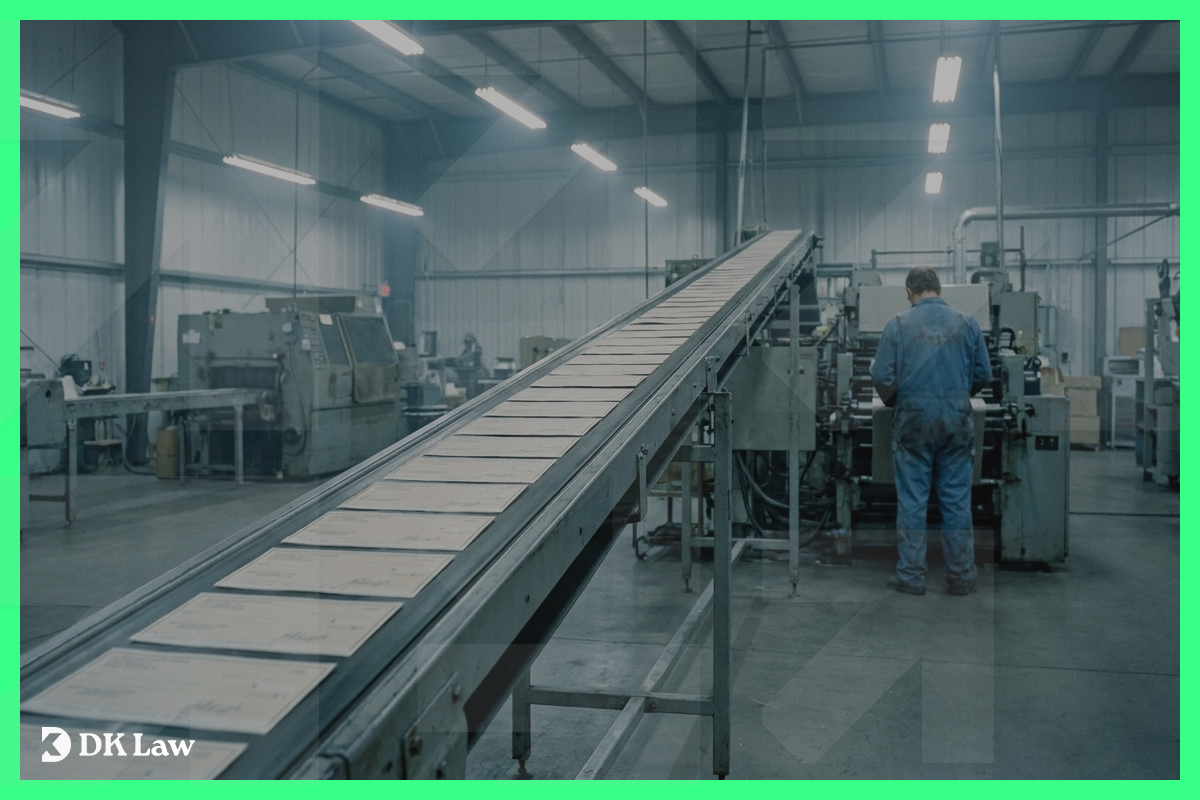
The phrase “settlement mill” gets thrown around like an insult, usually by one firm about another. But it started as a research term, and the person who coined it found something more complicated than “these firms are bad.” Nora Freeman Engstrom, a law professor at Stanford, studied these high-volume practices up close and defined them as firms that “aggressively advertise and mass produce the resolution of claims, typically with little client interaction and without initiating lawsuits, much less taking claims to trial.”
Her work is still the foundational study on the subject, and it’s worth understanding what she actually found before you decide whether the firm handling your case is one.
Here’s the uncomfortable part. If your injury is minor, a mill might get you paid faster than a firm that does everything by the book. The trouble starts when your injury isn’t minor.
Key Takeaways
- A “settlement mill” is a defined type of high-volume personal injury practice, not just a slur. It advertises heavily, resolves claims fast, rarely files lawsuits, and often hands the actual negotiating to non-lawyer staff.
- The model can work acceptably for small, routine claims. Engstrom’s research found that people with minor injuries often get “prompt, relatively certain, and comparatively generous payouts.” The seriously injured are the ones who lose.
- Most personal injury cases settle without a trial, and that is completely normal. Only about 4% of tort cases are resolved by trial. Settling is not the warning sign.
- The warning sign is a firm that settles because it can’t or won’t do anything else. A negotiator with no credible ability to file suit and try the case has almost no leverage, and insurers know it.
- “Settlement mill” is a spectrum. A legitimate firm can share a few traits without being one. What separates a true mill from a serious firm is whether it can actually build and try a case when it has to.
The term came from research, not a rival firm’s blog
Engstrom’s study, published in the Georgetown Journal of Legal Ethics, wasn’t an attack piece. She interviewed dozens of people who worked inside these firms and dug through court and disciplinary records. What she described was a business model, one built around speed and volume rather than fraud.
The math tells the story. A conventional injury lawyer might serve around 110 clients a year and carry roughly 70 open files. A mill negotiator can juggle 200 to 300 open files at once and handle 300 to 400 clients a year. You don’t hit those numbers by investigating each crash and preparing each case for a jury. You hit them by settling everything quickly, at standardized rates, and moving on.
Signs of a settlement mill
Engstrom identified a set of characteristics that show up across these firms. Stripped down to what you’d actually notice as a client, the pattern looks like this:
- You rarely, if ever, talk to an actual attorney. A case manager or paralegal runs your file start to finish. Under ABA Rule 1.4, your lawyer is supposed to keep you informed and tell you the substance of any settlement offer. Some mill clients never learned what number was demanded, or accepted, on their behalf.
- Nobody really investigates. They collect your medical bills and wait. Engstrom found mills routinely “short-circuit or skip altogether” the factual investigation a case needs.
- The firm almost never files lawsuits. Settling is normal. Never being willing to sue is not. It tells the insurance company there’s no trial to fear.
- Everything moves fast. Mill cases often resolve within eight months, sometimes as little as two. Speed is the product.
- A non-lawyer negotiates your settlement. Rule 5.3 allows paralegals to do a lot, but a supervising attorney must ensure their work meets a lawyer’s professional obligations. Handing a non-lawyer the actual job of valuing and negotiating your claim is what has gotten firms in trouble with bar regulators.
- The fee agreement quietly discourages trial. Engstrom found some mills used tiered contingency fees that spiked if a case went to court, structured, in one founder’s own words, to “convince people with very small suits not suited for trial to settle.”
One trait alone doesn’t make a mill. Plenty of good firms advertise and carry real volume. It’s the whole pattern, especially the parts about investigation and trial, that tells you what you’re dealing with.
Signs your firm is built to actually try your case
The contrast isn’t about being smaller or advertising less. It’s about capability:
- You can talk to an attorney about strategy, not just leave messages with support staff.
- Someone investigates the accident. Depending on the case, that means accident reconstruction, medical experts who tie your injury to the crash, and a real workup of what happened.
- The firm files lawsuits and tries cases. It doesn’t want to try every case – nobody does, but the insurer knows it will if the offer is unfair.
- An attorney values and negotiates your claim, consistent with the diligence Rule 1.3 and competence Rule 1.1 require.
- The case takes as long as it takes. Serious cases aren’t fast, and a firm that isn’t racing the clock is a firm that isn’t leaving money on the table to clear its desk.
Why most cases settling is not the red flag
People hear “this firm settles almost all its cases” and assume the worst. But nearly every firm settles almost all its cases. That’s how the system works.
According to the U.S. Bureau of Justice Statistics, bench and jury trials accounted for roughly 4% of all tort dispositions in its most recent comprehensive national survey. The other 96% were resolved in other ways, most of them by settlement. A firm settling your case isn’t cutting a corner. It’s doing the normal thing.
So the question was never “do they settle?” It’s “what happens if the insurance company won’t offer what the case is worth?” That’s where mills and serious firms split, and it has nothing to do with how often either one ends up in front of a jury.
The real difference is leverage
Settlements don’t happen in a vacuum. Both sides are guessing at what would happen if the case went to trial, and they bargain toward that number. Lawyers call it bargaining in the shadow of the trial. The stronger your trial threat, the more the other side has to offer to make you go away.
Engstrom’s sharpest finding is about what happens when that threat isn’t real. A mill negotiator, she wrote, is “virtually unarmed.” No detailed knowledge of your specific claim. No verdict history from similar cases. And no proven willingness to actually file a lawsuit and see it through. So the parties end up bargaining “in only the dimmest shadow of the law,” and the settlement “bears little resemblance to any hypothetical trial outcome.”
The insurance company has your firm’s number. If an adjuster knows a firm never files suit, there’s no reason to fear one. The opening lowball can stay a lowball. Why pay more to avoid a trial that’s never coming?
This is also why mills can be fine for a fender-bender and terrible for a spinal injury. On a small soft-tissue claim, the “going rate” the mill settles for might be close to the claim’s actual value, sometimes even a bit more, because the insurer also wants it off the books cheaply and quickly.
On a serious claim worth real money, that same formulaic, no-leverage approach leaves an enormous amount on the table. Engstrom put it plainly: the clients “least apt to benefit” from the mill model are those “who have meritorious claims and have been seriously injured.”
What a serious case actually takes
A minor claim runs on medical bills and a treating doctor’s notes. A serious one doesn’t.
When someone is catastrophically hurt, proving the case takes an infrastructure that a churn model isn’t built to provide. Accident reconstruction to establish how the crash happened and who caused it.
Medical specialists to tie the injury to the collision and explain what it means long-term. A life care planner to project decades of future treatment and attendant care. A vocational expert to show what the person can no longer earn. An economist to reduce all of it to a present-day number a jury can understand.
That work is expensive and slow. It’s the opposite of the mill model, which depends on skipping exactly this kind of investigation to keep the assembly line moving. A firm that has never built a case this way, and has no intention of trying one, cannot credibly threaten to take a serious injury to a jury. Which brings us right back to leverage.
The ethics rules draw the same line
This isn’t only a strategy question. Several of the practices that define a pure mill run straight into a lawyer’s professional obligations.
The ABA Model Rules of Professional Conduct require a lawyer to act with reasonable diligence, and the official comment adds that “a lawyer’s workload must be controlled so that each matter can be handled competently.” Three hundred open files per negotiator tests that.
Rule 1.4 says a lawyer must keep you reasonably informed and, when a settlement offer comes in, “must promptly inform the client of its substance.” Some mill clients never learned what number was demanded on their behalf, or accepted, until it was done.
And Rule 5.3 governs non-lawyer staff. Paralegals and case managers can do a lot, and good firms rely on them heavily. But the rule requires a supervising attorney to make sure their work is “compatible with the professional obligations of the lawyer.” Handing a non-lawyer the actual job of valuing and negotiating your claim, with the attorney barely involved, is where firms have gotten into real trouble with bar regulators.
Even fees connect to it. Rule 1.5 requires fees to be reasonable and judges them partly on the skill and work involved. Engstrom found some mills used tiered contingency fees that jumped if a case went to trial, structured, in one founder’s own words, to “convince people with very small suits not suited for trial to settle it.” A fee designed to talk you out of your day in court is a strange thing to find in an agreement that’s supposed to protect you.
How to tell where your firm sits
None of this means a busy firm is a bad one. Volume, advertising, a big support staff, none of that makes a mill. Being a pure settlement mill is about capability: whether the firm can and will do the hard version of the job when your case needs it.
A few questions cut through it fast.
- Did anyone investigate the details of your crash, or did they just collect your bills and wait?
- Does the firm file lawsuits and try cases, and how many did it take to trial last year?
- Is an attorney ready to negotiate your settlement if necessary?
- And if the insurance company lowballs you, what exactly happens next?
A firm built for serious cases will have real answers. A pure mill will get vague because the honest answer is that the assembly line has only one setting.
If you’ve been seriously hurt in California and you’re not sure the firm handling your claim is built to fight for it, talk to DK Law about a free consultation. Ask us the same questions.
DK All the way


From Your Case to Compensation, we take your case all the way.
Schedule a Free Consultation
Get Expert Legal Advice at Zero Cost.
At DK Law we’re with you – all the way.
Get a Free Consultation with our experts today!

No comments:
Post a Comment